
This is a guest post from Crowstep Digital, a Stirling web design and local SEO studio that works with trades and home improvement businesses across Central Scotland.
A staircase is one of the few pieces of joinery that you use every single day, and it is often the first thing a visitor sees when they step into your hall. Replacing a tired, creaking stair or adding a new one for a loft conversion can change how a whole house feels. It is also a project with more decisions in it than most homeowners expect. This guide walks through the main things to think about before you commission a bespoke timber staircase in Stirling, so that your first conversation with a joiner is a productive one.
Why choose a bespoke staircase?
Off-the-shelf stair kits are made to standard sizes. Many homes around Stirling are not standard. Victorian villas in the King’s Park area, older cottages in the surrounding villages and modern extensions all come with their own quirks: walls that are not quite square, floor-to-floor heights that vary, and tight landings where a door swing or a window gets in the way. A staircase made to measure is designed around the space you actually have, rather than the space a catalogue assumes. That usually means a better fit, a more comfortable climb and a finish that looks as though it belongs in the house.
Bespoke also gives you choice. You decide the timber, the shape of the handrail, the style of the balusters and whether the treads are left natural or painted. If you are restoring a period property, a joiner can often match the profile of an original handrail or newel cap so the new work sits comfortably alongside what is already there.
Start with the space, not the style
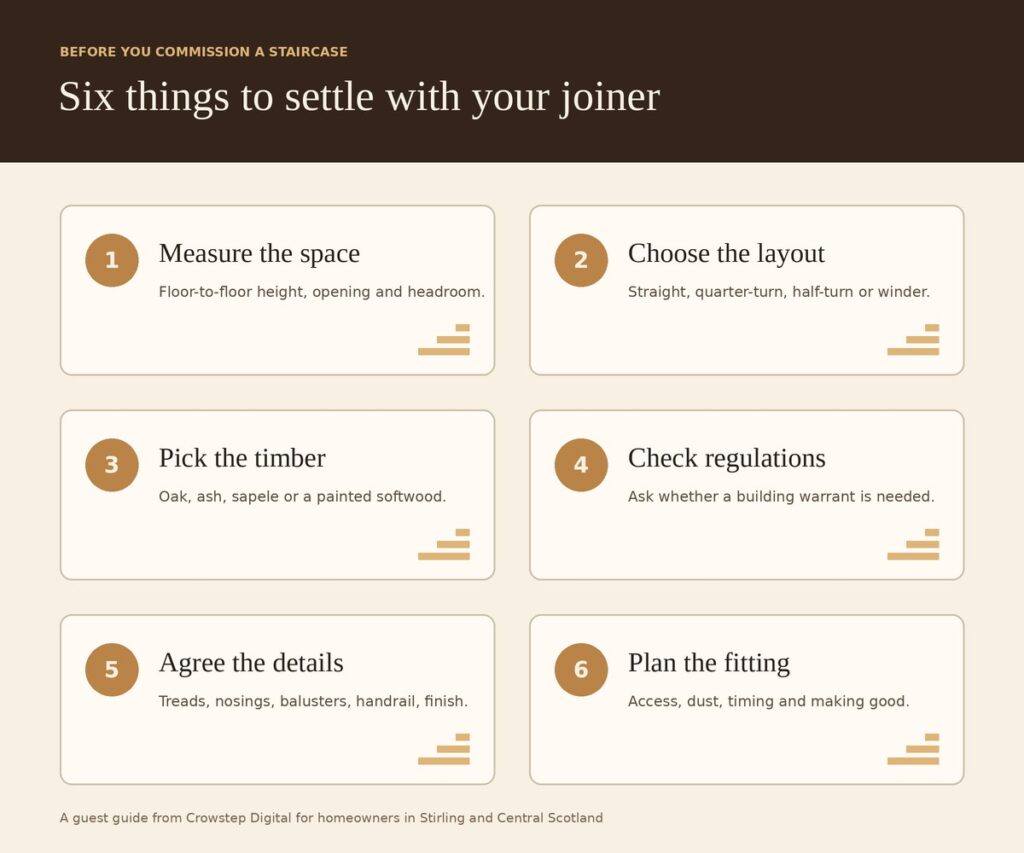
It is tempting to begin with photos of beautiful staircases, but the layout of your home decides what is possible. Before you speak to anyone, it helps to note a few basics: the height from finished floor to finished floor, the size of the opening in the upper floor, where doors and windows sit near the top and bottom, and how much headroom there is above the line of the stair. Rough measurements and a few photographs are enough at this stage. Your joiner will take precise measurements during a survey.
The space will also guide the layout. A straight flight is the simplest to build and to carry furniture up. A quarter-turn or half-turn stair with a landing can fit into a shorter footprint and break up a long climb. Winders, the tapered steps that turn a corner, save even more space but need careful design so they remain comfortable and safe to use. A good joiner will explain the trade-offs for your particular hallway.
Choosing the timber
The timber you choose affects the look, the feel underfoot and how the stair will wear over the years. Oak is a popular choice for its strength and grain, and it suits both traditional and contemporary homes. Ash is pale and hard-wearing, with a clean, modern look. Sapele and other hardwoods offer a warmer, richer colour. A painted softwood staircase can be a sensible option when the stair is going to be carpeted or painted to match the walls, perhaps combined with hardwood handrails for a touch of contrast.
Ask your joiner where the timber comes from, how it has been dried and how it will be finished. Oils, lacquers and paints all behave differently on a surface that sees daily foot traffic, so it is worth talking through how much upkeep you are happy with.
Regulations and safety
Stairs are covered by the Scottish building standards, which set out requirements for things such as the rise and going of each step, headroom, handrails and the gaps in a balustrade. If your staircase is part of wider work, such as a loft conversion or an extension, you may need a building warrant from Stirling Council before work starts. Replacing a stair like-for-like can be simpler, but it is always worth checking rather than assuming. An experienced local joiner will know the standards and can tell you early on whether your plans are likely to need a warrant, which avoids unpleasant surprises halfway through a project.
The details that make the difference
Once the layout and timber are settled, the smaller details bring a staircase to life. Think about the shape of the nosings at the front of each tread, whether you want open or closed risers, the style of the newel posts and caps, and whether the balustrade should be traditional spindles, square balusters, or glass for a lighter, more open feel. Small choices like these change the character of the hallway, so ask to see samples or photographs of previous work so you can picture the finished result.
Planning the fitting
Replacing a staircase affects how you move around your home, so plan the fitting with your joiner. Ask how long the old stair will be out of use, how dust will be controlled, whether there will be any temporary access to the upper floor, and who is responsible for making good the plaster and decoration afterwards. Much of a bespoke stair is usually made in a workshop and then installed on site, which helps keep disruption in the house to a minimum.
Finding the right joiner in Stirling
Most people now begin the search for a joiner online, typing something like “bespoke staircases Stirling” into Google or checking the map results. That is a sensible place to start, but a high position in the results tells you that a business is easy to find, not necessarily that it is the right fit for your project. Take the time to look beyond the first listing you see.
Look for a joiner who shows real photographs of staircases they have made, explains how they work and gives a clear way to get in touch. A complete Google Business Profile with genuine reviews, an address or service area you recognise and a website that describes the services in plain language are all good signs that you are dealing with an established local business. As a Stirling local SEO and website design agency, we see every day how much difference a clear, honest online presence makes to homeowners trying to choose the right tradesperson.
When you get in touch, share your rough measurements, photos of the current stair and the space around it, the timber and style you have in mind, and any timescale you are working to. Ask whether a site visit is included, what the quote covers, and how changes are handled if you alter the design along the way. A joiner who asks you thoughtful questions in return is usually one who will take care over the job.
Ready to take the first step?
A well-made timber staircase should serve your home for decades, so it is worth investing a little time in planning before any timber is cut. Work out your space, think about the layout and materials, check the regulations, and choose a joiner whose work you can see and trust. If you are thinking about a new staircase for your home in Stirling or the surrounding area, take a look at our bespoke timber staircases page or get in touch to talk through your ideas.